Performance enhancing substances are used to increase athletic performance, promote muscles growth, and increase an individual's capacity for exercise. Many students take performance enhancing substances to boost their athletic performance, build muscle, increase their body mass or to lose weight. This can be because of the negative influence that society plays with body images, or because of peer pressure. The negatives of steroids outweigh the positives, they can damage a person's mental and physical health and many are illegal. They can also cause "roid rage", mood swings, paranoia, anxiety, depression and suicidal thoughts. Most steroids come with negatives, but some like massages and myofascial release help relax the muscles and have no discernible negatives. I think that it's worrisome that there's so many students who are taking steroids, and that they feel like they have to meet some expectation to look a certain way because of external influences, and today people value body image more than their mental and physical health. Below, we created a satirical ad about aging, mimicking the way that many drug companies pitch their product to their consumer base.
Wednesday, March 23, 2016
Tuesday, March 22, 2016
Why did the chicken cross the road? To get to the dissecting tray!
For this lab we dissected a chicken to observe the various muscle groups and parts to see how they interact with each other. Muscles, bones, and tendons work together to facilitate the movement of the body. The tendon attaches muscle to bone and allows the muscle to work at its full capacity by withstanding the tensile strength and spring of the muscle when it contracts and elongates.
An example of this is the supinator tendon that works to bend the forearm and rotate it, which is why its called the supinator tendon because it helps with supination. It also works with the biceps brachii muscles that works with other muscles to help with the supination process.
The origin is where the tendon attaches to a generally immovable bone - some muscles have two or more of these that change their naming conventions - like the triceps and biceps in the arm. The insertion point is where the tendon attaches to a more movable bone. Because of this different in movement, the origin, which is generally stationary, contracts the muscles towards itself while the insertion point is more distal and moves when the muscles contracts.
In chicken the pectoralis major and minor muscles are generally larger than in humans because chickens are generally bred - through artificial selection and some genetic modification - for their breast meat. They also have a larger tibialis posterior and anterior for the same reasons, artificial selection for a greater supply of chicken meat for consumption. A human's trapezius muscles is much more well defined than that of a chicken, because relative to their body mass, chicken's have a very small head so they do not need a large muscle to control and support it. Humans on the other hand, need large trapezius muscles to help keep the head supported and straight throughout the day.
Below are pictures that we took during the lab:
![]() |
| View of skinned chicken before dissection |
![]() |
| Pectoralis Major: Movement of the shoulder joint Pectoralis Minor: Elevates/Depresses scapula and shoulders |
![]() |
| Latissimus Dorsi: Extension, Adduction and Flexion of the shoulder joint Trapezius: Move the scapula and support the arm/head |
![]() |
| Iliotibialis: Extend, adduct, and rotate the hip/leg |
![]() |
| Sartorius: Rotater and flexor of the hip joint. |
![]() |
| Semitendinosus: Works with other muscles to extend the hip and flex the knee Biceps femoris: Works for knee extension |
![]() |
| Semimembranosus: Leg flexion and rotation, thigh extender |
![]() |
| Quadriceps femoris: Powerful knee extenders |
![]() |
| Gastrocnemius: Plantar flexing of foot at ankle joint and flexor of leg at knee joint Tibialis anterior: Dorsiflexion and inversion of the ankle Peroneus Longus: Evert and plantar flex the ankle |
![]() |
| Brachioradialis: Strong elbow flexor Flexor carpi ulnaris: Flexion and adduction of hand |
Thursday, March 17, 2016
20 Time - Mickey Mouse
I worked on creating the first coloring page of my book this week. I decided the only true way to kick off the coloring book would be with one of my favorite characters of all time - Mickey Mouse. Going through the steps of finding what to draw and how to fill in the patterns was a lot more difficult than I thought it would be. There was the issue of trying to find out what stance to put Mickey in to make sure that the outline was still discernible to the audience, and what patterns to fill up the outline with. I decided that I would try and go for more of a flow-y style with a bunch of circles, but then I realized that it was becoming really monotonous to draw and wasn't giving much style. I added some different patterns, but still tried to make sure that those patterns were repeated enough times since that's part of the reason that coloring books are considered to be a de-stressing tool.
I first sketched out the outline in pencil, and then went over the outline in pen so I could erase the designs inside without worrying about erasing the outline itself. I started off with wide circles and worked my way up the outline, adding mandala patterns to the ear area. After erasing the pencil, I thought it would be fitting to also show the work that my eraser went through, since it started off new. Overall, I think that I could have done better on the pattern, I don't think it goes together very well so I'll probably try just sticking with one repetitive pattern outlined in different shapes than trying to merge a bunch of different ones next time. I'll probably try and make the next one more specific to SHS and Saratoga rather than something general like Disney, so it can affect the community on a more personal scale.
Wednesday, March 9, 2016
"What Happens When We Stretch" Article Notes
"Hence when you stretch, the muscle fiber is pulled out to its full length sarcomere by sarcomere, and then the connective tissue take up the remaining slack. When this occurs, it helps to realign any disorganized fibers in the direction of the tension. "
I think that this really shows the importance of stretching. Stretching can be used to help bring scarred tissue back to health, since one of the characteristics of scarred tissue is the fact that it is not aligned with the tissue around it. The connective tissue and muscle fibers work together to make sure that the muscle is stretched as far as it can, and that helps increase the mobility of the muscles when they go back to that stretching position in a workout or an exercise. It would help lengthen your muscles to their full capacity, since your muscles are longest when they are stretched out and when the fibers are as far as they can go.
"Another reason for holding a stretch for a prolonged period of time is to allow this lengthening reaction to occur, thus helping the stretched muscle to relax. It is easier to stretch, or lengthen, a muscles when it is not trying to contract."
This shows the importance of the golgi tendon organ in the body. Because of its signaling capabilities to the spinal cord, it is able to overcome the signaling of the muscles to tell the muscles to contract. The basic function of the organ is to help protect the muscles, tendons, and ligaments from injury. The tendon records the changes in tension, and the rate of change of that tension, and through the spine, conveys that information to the body. When the tension exceeds a certain threshold, it triggers a lengthening reaction in the muscles.
"Only consummate professional athletes and dancers at the top of their sport or art are believed to actually possess this level of muscular control."
It shows how extensive the training that the athletes/performers go through to get to the level that they are at. They go through such intensive training that the stretch reflex of the muscles has little or even no reflex contraction in response to a sudden stretch. This comes at a high cost though, it provides a high risk of injury if used incorrectly.
This article re-emphasizes what we've been learning about muscles and their roles in the body. It talks about the myosin and actin filaments that work to pull the muscle to its full length. It also discusses the impact that stretching has on the muscles and these filaments, and how stretching can actually be used to realign these filaments, and as a result, help realign misaligned scar tissue. It was also interesting to see how people can actually stretch to their full capacity and bypass natural safeguards to lengthen their muscles to the fullest extent.
I think that this really shows the importance of stretching. Stretching can be used to help bring scarred tissue back to health, since one of the characteristics of scarred tissue is the fact that it is not aligned with the tissue around it. The connective tissue and muscle fibers work together to make sure that the muscle is stretched as far as it can, and that helps increase the mobility of the muscles when they go back to that stretching position in a workout or an exercise. It would help lengthen your muscles to their full capacity, since your muscles are longest when they are stretched out and when the fibers are as far as they can go.
"Another reason for holding a stretch for a prolonged period of time is to allow this lengthening reaction to occur, thus helping the stretched muscle to relax. It is easier to stretch, or lengthen, a muscles when it is not trying to contract."
This shows the importance of the golgi tendon organ in the body. Because of its signaling capabilities to the spinal cord, it is able to overcome the signaling of the muscles to tell the muscles to contract. The basic function of the organ is to help protect the muscles, tendons, and ligaments from injury. The tendon records the changes in tension, and the rate of change of that tension, and through the spine, conveys that information to the body. When the tension exceeds a certain threshold, it triggers a lengthening reaction in the muscles.
"Only consummate professional athletes and dancers at the top of their sport or art are believed to actually possess this level of muscular control."
It shows how extensive the training that the athletes/performers go through to get to the level that they are at. They go through such intensive training that the stretch reflex of the muscles has little or even no reflex contraction in response to a sudden stretch. This comes at a high cost though, it provides a high risk of injury if used incorrectly.
This article re-emphasizes what we've been learning about muscles and their roles in the body. It talks about the myosin and actin filaments that work to pull the muscle to its full length. It also discusses the impact that stretching has on the muscles and these filaments, and how stretching can actually be used to realign these filaments, and as a result, help realign misaligned scar tissue. It was also interesting to see how people can actually stretch to their full capacity and bypass natural safeguards to lengthen their muscles to the fullest extent.
Wednesday, March 2, 2016
Unit 6 Reflection
What is a skeleton's favorite instrument?
A tromBONE!
Besides the puns, in this unit we learned about the skeletal system and its functions in the body. We explored the different bones and their locations in the body, then went deeper and explored the hormones and structure that affect the bones themselves. By completing labs such as the Owl Pellet Dissection Lab where we got to apply what we had learned and try to reconstruct a skeleton from a Barn Owl pellet.
I would want to learn more about the diseases that can affect the skeletal system, and go into not only the reasons why they are caused but also the ways that people can recover from them, and if there is a recovery plan at all. By applying it more to the real world I think that it would help us remember a lot of the technical details of the systems and really bring the unit together.
I've sort of been failing at my New Year's goals. I promised myself that I would get more sleep, but turns out the amount of sleep I've been getting has dropped. On the other hand, I'm really excited about by 20 Time project of creating a coloring book and I can't wait to get into that in more detail and go through the process of creating something from scratch.
A tromBONE!
Besides the puns, in this unit we learned about the skeletal system and its functions in the body. We explored the different bones and their locations in the body, then went deeper and explored the hormones and structure that affect the bones themselves. By completing labs such as the Owl Pellet Dissection Lab where we got to apply what we had learned and try to reconstruct a skeleton from a Barn Owl pellet.
We learned how the bones connected to each other in different ways. One of the things that I was surprised about was that the teeth are actually connected by joints. Immovable joints, but it was interesting to expand what the word joint meant to me, since before I only thought that joints were movable.
This unit was really interesting to learn about. There were so many dysfunctions in the skeletal system that I was unaware about, like kyphosis and lordosis. It was also really cool to see everything relate back to having good health and keeping a healthy diet, since conditions like osteoporosis can arise from things like smoking and poor diet and exercise.
I've sort of been failing at my New Year's goals. I promised myself that I would get more sleep, but turns out the amount of sleep I've been getting has dropped. On the other hand, I'm really excited about by 20 Time project of creating a coloring book and I can't wait to get into that in more detail and go through the process of creating something from scratch.
Monday, February 29, 2016
Teen Coloring Books
In Anatomy, we are working on a project called 20 Time. 20 Time is when you spend 20% of your time working on whatever inspires or motivates you, usually with an altruistic motive to give back to the community fueling the approach. It's used in big companies such as Google, where 20 Time projects gave way to bigger things. For example, on employee felt that the current mail system was too slow, so he created Gmail.
For my 20 Time project, I wanted to know different/healthy ways to reduce student stress. After researching the topic, I found out about coloring books that were tailored to adults, filled with intricate drawings of mandalas and other patterns. Although not described as form of art therapy, there was evidence showing how coloring reduced stress, increased focus, and led to an overall better sense of self. I decided that I wanted to draw my own coloring book and make it an in-between of an adult coloring book and a child's. I want to include the basic mandala designs inside of an outline that brings teens back to their childhood.
At the end of this project, I want to have the start of a coloring book, and I can do this by doing a creating page a week. If I continue to follow those outlines, then by the end of the project I should have the beginnings of a complete coloring book with about 14 pages inside of it.
Some challenges will be trying not to make the patterns in the book overly repetitive and coming up with new and interesting ways/ patterns to keep the audience occupied. Below is an example of a pattern that I want to try to draw sometime in the process :)
For my 20 Time project, I wanted to know different/healthy ways to reduce student stress. After researching the topic, I found out about coloring books that were tailored to adults, filled with intricate drawings of mandalas and other patterns. Although not described as form of art therapy, there was evidence showing how coloring reduced stress, increased focus, and led to an overall better sense of self. I decided that I wanted to draw my own coloring book and make it an in-between of an adult coloring book and a child's. I want to include the basic mandala designs inside of an outline that brings teens back to their childhood.
At the end of this project, I want to have the start of a coloring book, and I can do this by doing a creating page a week. If I continue to follow those outlines, then by the end of the project I should have the beginnings of a complete coloring book with about 14 pages inside of it.
Some challenges will be trying not to make the patterns in the book overly repetitive and coming up with new and interesting ways/ patterns to keep the audience occupied. Below is an example of a pattern that I want to try to draw sometime in the process :)
Friday, February 26, 2016
Owl Pellet Dissection
In this lab, we did a dry dissection of a barn owl's pellet. The pellet is formed from all of the indigestrible materials obtained when a owl eats. It compacts all these indigestible materials, like bones and feathers, and regurgitate them. Since an owl's diet primiarily consists of small rodents such as mice, voles, and shrews, we hypothesized in the beginning that we would get one of those animals.
![]() |
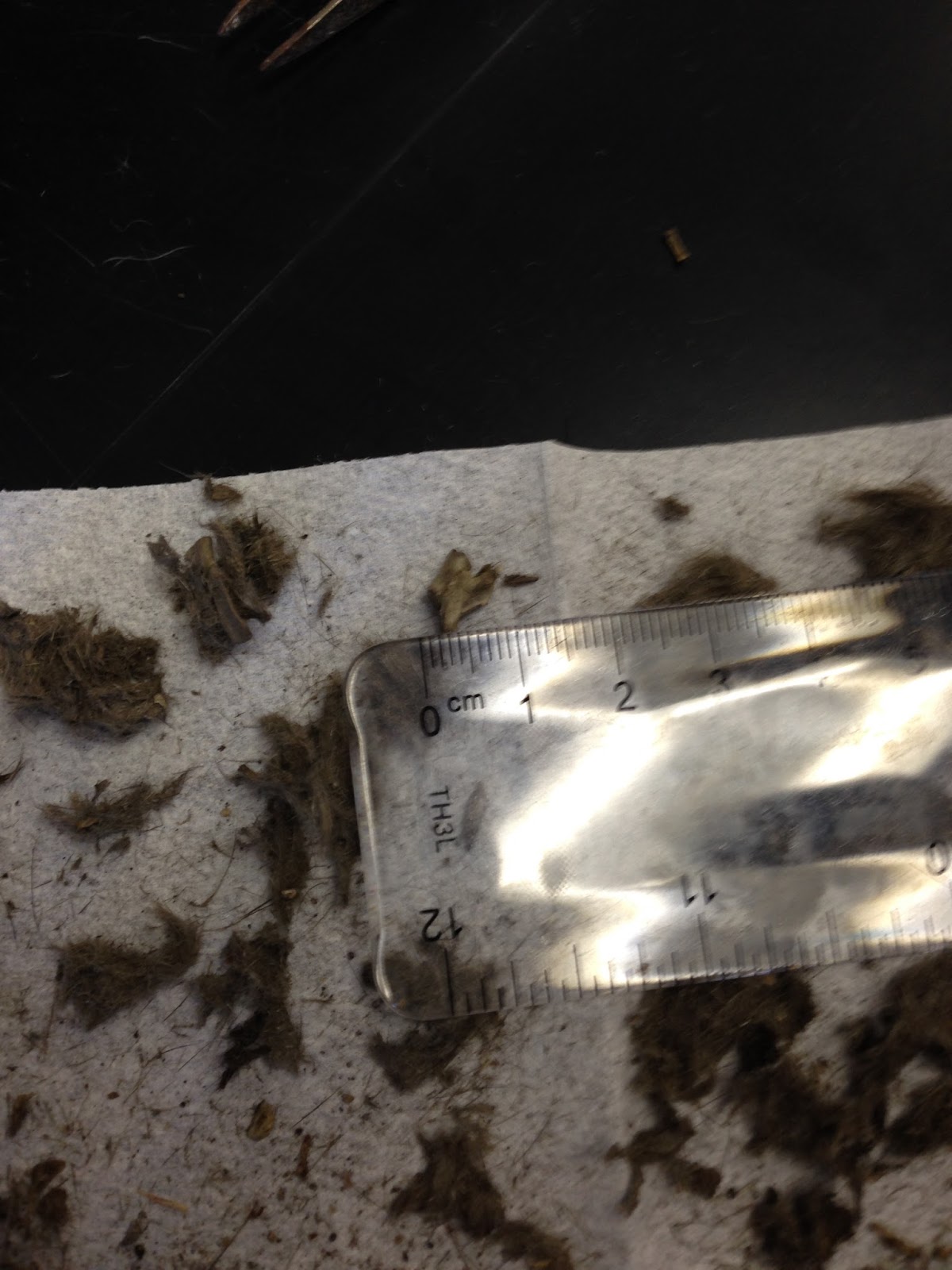
| Pellet Mass: 10.72g Length: 6.5 cm Width: 3.3 cm Heigh: 2.4 cm |
![]() |
| Pellet next to ruler for scale |
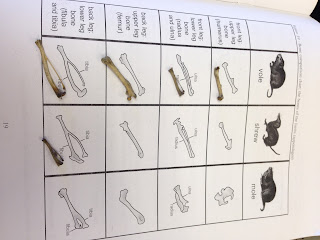
Inside of our owl pellet, we think that we had two small rodents: a vole, and a shrew. When we compared the bones that we found and measured them, we found two different sizes of bones and leg bones. Two of the bones were the size of a vole, but then the other one was slightly smaller and had a different end than a vole leg bone, making it a shrew. In addition, we found two bones that came together to form a complete shrew pelvis, confirming what we suspected: that there were two animals in the pellet. Since voles are larger than shrews, we measured each of the bones and categorized the larger and thicker ones to the vole and the smaller and skinnier ones (especially the extra leg bones) to the shrew. The average size of the vole's leg bones was about 15 cm long, and the average size of the shrew was about 10 cm.
![]() |
| Comparison of bones |
Compare/Contrast to Humans:
![]() |
| Comparison of Human and Shrew Pelvis |
The pelvis of a shrew is more elongated than a human pelvis. The ischium loops are much bigger, and rather than being round they form a oval shape and the other bones stick out from the ischium to make a dagger-like shape, which the human pelvis does not have. The pelvis also seems to be broken into two parts, although that may also be from the barn owl digestion. Both pelvis's have the same ischium loops, albeit in different lengths, and come to support the hips and attach to the legs with the same sort of joints. Although humans and voles walk in different ways, the pelvis still attaches to the femur in roughly the same way.
![]() |
| Mandible Comparison |
The jaw of the vole differs from the jaw of the human as well. A human's mandible is more U-shaped, while the jaw of a vole resembled more of a V-shape and is sharper. The teeth of a ole are also sharper as well, with the only "sharp" teeth in the human mouth are the canines, and even then it doesn't reach the sharpness of a vole tooth. The difference is tooth structure signifies the difference between diets of the human and the vole as well. Both the mandible from the humans and the voles hinge to the skull/cranium/maxilla area, and are connected with the same type of joints that allow the crushing and grinding motions needed to start the digestive process.
In a human leg, the tibia is the load-bearing bone and is larger and thicker than the lateral fibula. However, in a vole, the opposite is true. The fibula is thicker than the tibia, suggesting that the fibula is the load bearing bone opposed to the tibia. The tibia and fibula are also fused together into one bone, while in the human skeleton, they remain as two bones. However, in both skeletons, the flared ends of the bones are there, the epiphyses area, which is where the bones attach to the other bones, either the patella or the talus. It is also clear in both structures that the bones are used for the same purpose of movement, although they have different load-bearing bones.
![]() |
| Another picture of vertebra |
![]() |
| One of the vertebra we found in the pellet |
Subscribe to:
Posts (Atom)